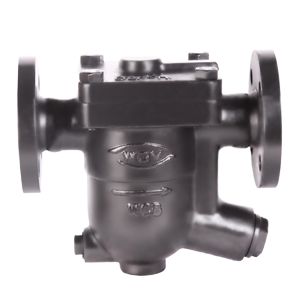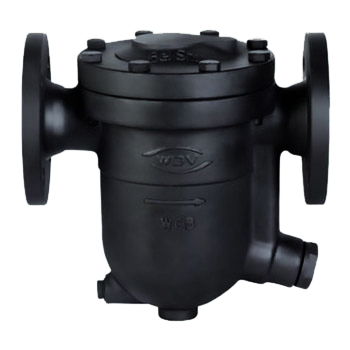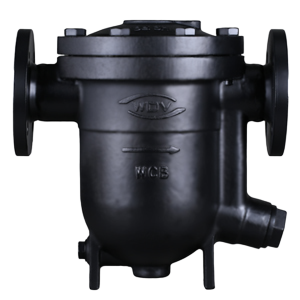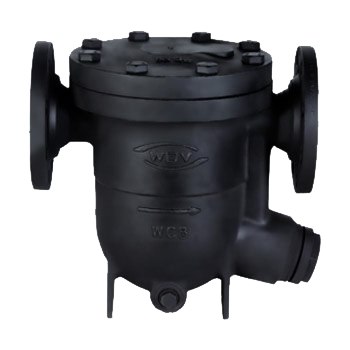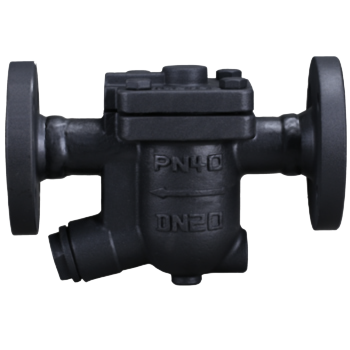
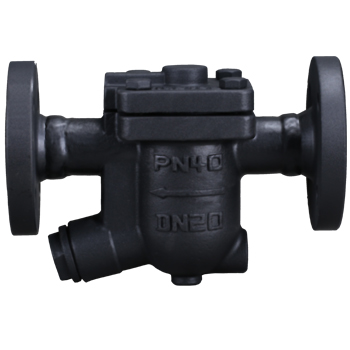
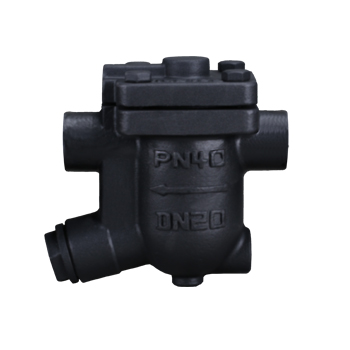
Free-Ball Float Trap 3N
Overview
Product Introduction:
Free-ball float trap
The drain valve is opened or closed by taking advantage of the change of liquid level of condensate water with the high-precision grinding stainless steel hollow float ball in the valve cavity. This steam trap has a simple structure, mainly consisting of float balls and automatic emptying devices. The sole action elements, namely, the stainless steel hollow float ball is manufactured by high-precision grinding process, and its entire sphere can serve as the sealing face and will not be worn intensively during the work, so it has a longer service life. In addition, there is no wearing part in the valve cavity, with a high reliability. The float ball can freely adjust the openness of the valve opening in response to the change of water level and discharge the condensate water continuously with a subcooled temperature of about 0℃ and higher efficiency.
The automatic emptying devices fall into two types: (within low pressure PN25) consisting of reservoir thermo-sensitive elements and (overheated steam system) consisting of bimetals.
Merits:
1. The sole moving component is the high-precision grinding stainless float ball, which can resist erosion.
2. Its simple structure is convenient for maintenance.
3. To drain continuously with low noise, without being affected by the fluctuation of the pressure.
4. To be equipped with automatic emptying devices and it can eliminate air quickly and prevent air blocking and steam locking.
5. Small volume and large displacement.
6. To drain whenever there is water left over so as to quicken the startup speed of the system.
Materials of Primary Components
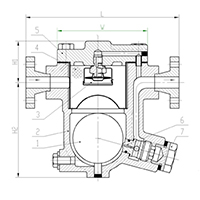
The materials of primary accessories
|
Part and Component Name |
Material |
|
Valve Body, Valve Cover |
Cast Iron, Cast Steel, Stainless Steel |
|
Free Float Ball |
304/316 Stainless Steel |
|
Valve Seat |
High Chrome Stainless Steel |
|
Automatic Air Exhaust |
Stainless Steel, Thermo-Sensitive Element |
|
Filter Screen, Cover |
Stainless Steel |
Diameter of Stainless Steel Ball
|
/Material |
A,JH3N |
B,JH5N |
D,JH7N |
E,JH9N |
F,JH11N |
G,JH13N |
|
Cast iron |
50 |
68 |
110 |
150 |
180 |
200 |
|
Cast steel |
50 |
70 |
120 |
150 |
190 |
220 |
Description of work principle:
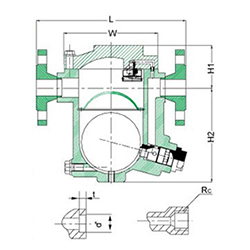
When the equipment is just started, the low-temperature condensate and air enter the valve cavity at the same time. The automatic air exhaust device opens at this point to expel the air, allowing the low-temperature condensate to enter the valve cavity smoothly. The condensate level in the valve cavity rises immediately, lifting the float ball and opening the valve port so that the condensate is discharged rapidly. Subsequent steam quickly enters the heating equipment, bringing it up to temperature rapidly. When steam or higher-temperature condensate enters the valve cavity, the automatic air exhaust device begins to expand and closes, and the steam trap starts its normal operation. The float ball then rises and falls with the condensate level, discharging condensate continuously. Since the valve seat port of the free-ball float trap always remains below the condensate level, a water seal is formed that naturally separates water from steam, so the trap operates without steam leakage. The minimum working pressure of the valve is 0.01 MPa; within the range from 0.01 MPa up to the maximum working pressure, the trap is unaffected by temperature and working-pressure fluctuations and can operate continuously. Its minimum subcooling is about 0℃. Because the valve automatically and continuously discharges condensate, no water accumulates in the heating equipment, allowing it to achieve ideal heat-exchange efficiency. It is one of the ideal steam traps for process heating equipment.
FREE-BALL FLOAT TRAP
Technical Parameters
|
Shell pressure grade |
Load leakage rate |
Used medium |
Shell material |
Permitted backpressure rate |
Maximum operating pressure differential |
|
1.6、2.5、4.0、6.4MPA |
≈0% |
Steam、Condensate water |
Carbon steel /304/316 |
≥80% |
4.0MPA |
|
Energy Saving effect |
Minimum Subcooled temperature |
Drainage method |
Maximum Allowable temperature |
Air exhaust system |
Pressure Change range |
|
Excellence |
0℃ |
Continue mode |
420℃ |
Automatic |
Adaption |
Prime out-form dimensions and weigh
|
Product model |
(DN) Calibre |
L Flange |
L/ Thread /welding |
H1 |
H2 |
W |
Weight |
(Mpa)Pressure change range |
(Mpa)Nominal pressure |
|
JH3N |
15~20 25 |
- |
195 215 |
55 |
90 |
95 |
3.61 |
0.1-2.5 |
2.5-4.0 |
|
JH3NF |
15~20 25 |
195 215 |
- |
55 |
90 |
95 |
5.5 |
0.1-2.5 |
2.5-4.0 |
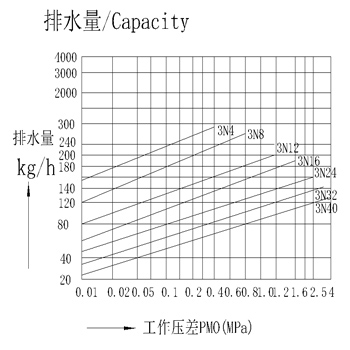
Capacity
Notes:
1. Please provide operating pressure and operating pressure difference, generating quantity of condensation water, operating temperature, connecting mode and standards in selecting product models.
2. The load of condensation water’s safety coefficient reaches 2 to 3 times in general.
3. Please make sure the drain valve is installed properly, maintained regularly, cleaned up and operates under the normal condition, so as to extend its service life.
4. The steam trap, if equipped with automatic exhaust valve, can have the quantity of condensate water increased by 300Kg/h.
Key specifications
| Valve body, valve cover | Cast iron, Cast steel, Stainless steel |
|---|---|
| Free float ball | 304/316 Stainless steel |
| Valve seat | High chrome stainless steel |
| Automatic air exhaust | Stainless steel, Thermo-sensitive element |
| Filtrating screen, Cover | Stainless steel |